

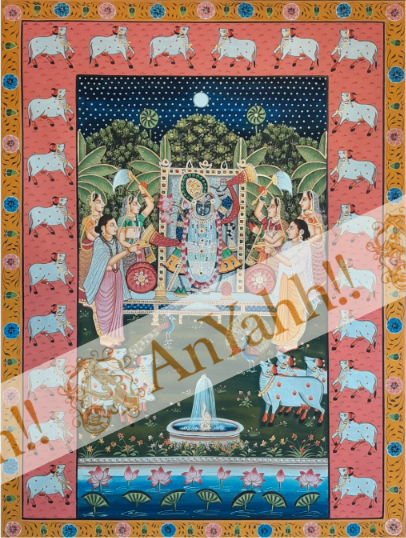
Discover the history and symbolism of Pichwai art and learn how to style traditional Pichwai paintings in your living room, pooja room and home.
Walk
into a home with a Pichwai painting on the wall and you'll notice it
immediately: the deep jewel tones, the gold detailing, the sense that the piece
is telling a story rather than just filling space. Pichwai paintings for home
décor have moved well beyond pooja rooms and temple courtyards; today they're
just as at home in a modern living room or a quiet reading corner. Here's what
makes this centuries-old art form so special, and how to bring it into your own
space.
What Is Pichwai Art?
Pichwai
literally means “that which hangs from the back” (pichh = back, wai = hanging).
Traditionally, these large cloth paintings were hung behind the idol of
Shrinathji, a child form of Lord Krishna, inside the Nathdwara temple in
Rajasthan. Each Pichwai was created to match a specific season, festival, or
mood of the deity, changing throughout the year as the backdrop to worship.
Over
time, the art form stepped outside the temple. Skilled artisans in and around
Nathdwara continued the tradition on a smaller scale, and today Pichwai
paintings are created as standalone works of art (on cloth, canvas, or paper)
meant to be collected and displayed at home.
A Brief History of Pichwai
Paintings
Pichwai
painting dates back over 400 years to the 17th century, rooted in the Pushtimarg
sect of Vaishnavism founded by Shri Vallabhacharya. When the idol of Shrinathji
was moved to Nathdwara in the late 1600s, local artists began painting
elaborate backdrops for the shrine, drawing on Mughal miniature techniques,
natural pigments, and gold leaf work.
Generations
of artisan families passed the craft down, and Nathdwara remains the heart of
Pichwai art today. What started as devotional temple art is now recognised as
one of India's most distinctive traditional painting styles, prized by collectors
and interior designers alike.
The Symbolism Behind
Pichwai Art
Every
element in a Pichwai painting carries meaning. Nothing is purely decorative:
•
Cows: represent
abundance, nourishment and Krishna's pastoral life in Vrindavan
•
Lotus flowers: symbolise
purity and spiritual awakening
•
Peacocks: associated
with beauty, grace and the monsoon season
•
Shrinathji's raised
hand: the central figure, often shown lifting Govardhan Hill, symbolising
protection
•
Seasonal motifs: many
Pichwais depict a specific festival or season, from Holi to Sharad Purnima
This
layered symbolism is part of why a Pichwai painting feels different from a
purely decorative artwork. It's rich with narrative, even to someone who isn't
familiar with the mythology.
Why Pichwai Paintings Are
Trending in Home Décor
Pichwai
art has had a real resurgence in Indian interior design over the last few
years. Designers are pairing it with both traditional and contemporary
interiors: the deep blues, greens and golds work beautifully against neutral,
earthy palettes, and the intricate detailing gives a room an instant focal
point without needing multiple accent pieces.
How to Style Pichwai
Paintings for Home
•
Living room feature
wall: Choose one large Pichwai painting as a standalone statement piece rather
than clustering it with other art. Let the detailing breathe.
•
Pooja room or mandir
corner: This is Pichwai art's original home. A Shrinathji-themed Pichwai above
or beside your mandir keeps the space true to tradition.
•
Entryway or foyer: A
mid-sized Pichwai near the entrance sets a warm, welcoming tone for guests.
•
Bedroom or reading nook:
Smaller, calmer motifs, like lotus or floral Pichwais, work well in more
intimate spaces.
•
Colour pairing: Pichwai
paintings sit beautifully against off-white, beige, sage green or deep charcoal
walls, letting the gold and jewel tones stand out.
•
Framing: A simple wooden
or antique-gold frame keeps the focus on the artwork; avoid overly modern or
glossy frames that clash with the traditional style.
Choosing the Right Pichwai
Painting for Your Space
Before
you buy, think about scale (measure your wall space and leave breathing room
around the piece), the dominant colour of the room it's going into, and whether
you want a devotional theme (Shrinathji, cows, lotus pond) or a more decorative
motif (peacocks, floral borders). Hand-painted pieces on cloth or canvas, done
by artisans trained in the traditional technique, will hold their colour and
detail far longer than printed reproductions.
Caring for Your Pichwai
Painting
Keep
your Pichwai painting out of direct sunlight to preserve its natural pigments,
dust it gently with a soft, dry cloth, and avoid hanging it in high-humidity
areas like bathrooms. With basic care, a well-made Pichwai painting easily lasts
generations, much like the temple tradition it comes from.
Bring Pichwai Art Into
Your Home
Pichwai
paintings carry centuries of craft, story and devotion into a single frame,
which is exactly what makes them such striking pieces for a home. Explore AnYahh's
curated Pichwai collection to find a
piece that fits your space, or browse our full art
collection for more traditional and
contemporary Indian art.